Chondrosarcoma Foundation Think Tank Topic 2: Early Detection
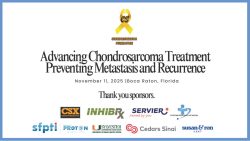
On November 11 in Boca Raton, Florida; the Chondrosarcoma Foundation hosted its first Think Tank entitled: Advancing Chondrosarcoma Treatment, Preventing Disease Progression, Recurrence & Metastasis. The first video of the think tank has been posted on the Chondrosarcoma Foundation web site, and we invite you to view it. The link to the video is: https://csfshayna.org/early-detection/
For use in: (1) Early detection of chondrosarcoma in a general population (2) Early detection of chondrosarcoma in a patient with risk factors (enchondromatosis, osteochondromatosis) (3) Early detection of metastasis in a patient with a history of chondrosarcoma. Can self-monitoring and medical screening tools for sarcoma / chondrosarcoma in combination with an education awareness campaign to assess lump growth, swelling, pain, and restricted mobility improve outcomes. Will the use of other tests such as liquid biopsies / ctDNA, scans for early detection improve outcomes. Are early detection strategies an effective deterrent to prevent disease progression, recurrence, and metastasis?
The panel addressed the roles of medical oncologists and orthopedic surgeons in the care of Chondrosarcoma patients, noting that many patients first see orthopedic specialists. The discussion included the prognostic importance of tumor grading, with a focus on the varying relapse rates and survivorship associated with different sub-types. The need for improved surveillance strategies, particularly for higher-grade tumors and those with genetic syndromes, was also emphasized.
Anthony P. Conley, M.D., is the Associate Professor of the Department of Sarcoma Medical Oncology, Division of Cancer Medicine at the University of Texas MD Anderson Cancer Center in Houston, TX. Dr. Conley addresses the challenges in diagnosing the complexities of the disease, including various sub-types and their genomic progression, particularly the significance of IDH1 mutations. He stressed the importance of understanding these mutations to implement treatment strategies and improve patient care.
Joseph H. Schwab, M.D., M.S., Director of Spine Oncology for Orthopaedic Surgery and Dir. of the Cedars-Sinai Center for Surgical Innovation and Engineering, Los Angeles, CA. Dr. Schwab presented a case study involving a 66-year-old woman diagnosed with Grade 2 Chondrosarcoma underscoring the importance of thorough diagnostic workups before surgical interventions. The discussion also covered the evolution of limb salvage surgery and the critical role of proper biopsy techniques in patient care.
Francis John Hornicek, M.D., Ph.D., is the professor and chair of the Department of Orthopaedics of the Miller School of Medicine for the University of Miami Health System in Miami, FL. Dr. Honecek elaborated on the complexities of diagnosing and treating cartilage tumors, noting that many are found incidentally and may be benign, highlighting the need for careful monitoring and differentiation between benign and malignant lesions.